Ever since I was a kid growing up in Ogden Utah back in the early 80's, I've been fascinated by the Spanish bullfight. I even searched out books on bullfighting at the Weber County library, where I found and read "Death in the Afternoon" by Ernest Hemingway. I'm probably the only kid in Utah to have ever read that book. Now here we are 40 years later and I still enjoy learning about and keeping up with the bullfights.

June 4, 2020

Mission Santa Barbara


Mission Santa Barbara was the twelfth mission built in California, founded December 4, 1786, by Father Fermin Lasuen. The name Mission Santa Barbara means is in honor of a fourth-century martyr, because it was founded on her feast day.

Interesting Facts

Mission Santa Barbara is the only one in constant operation by the Franciscan Order since its founding. Also, it is the only one mission with two bell towers.

1786 - 1800

The place that became Santa Barbara mission was shown on Spanish maps long before the beginning of the missionary era. The spot was named by Vizcaino about forty years after Spanish explorer Juan Cabrillo first discovered it in 1542.

The Catholic fathers were in California for 13 years before they founded Santa Barbara Mission, and they had a very difficult time in the beginning. Governor Felipe de Neve openly preferred colonists to Native American neophytes. However, at a meeting in San Gabriel, de Neve agreed to let the fathers start the Santa Barbara Mission. In 1782, a party set out from San Gabriel to found two new sites.
 
The town was founded without de Neve and the fathers moved on to Santa Barbara Mission, where de Neve joined them. The military presidio was established and Father Serra helped prepare the military chapel. However, when Father Serra wanted to start work, de Neve refused.
 
It would be four years before Santa Barbara Mission was finally founded. In the meanwhile, Father Serra returned to Carmel, where he sickened and died in 1784. De Neve was replaced by former governor Pedro Fages. Fages was not friendly to the missionaries either, but finally, he gave permission to start. Father Fermin Lasuen presided over the founding on December 4, 1786, the day of the feast of Saint Barbara.

Lasuen left Father Antonio Paterna in charge, and he supervised early construction. Santa Barbara mission had good luck from its beginning. The first permanent church was completed in 1789. Within five years, it became too small for the growing population and it was replaced.

The native people liked the fathers and soon there were more than 1700 neophytes living in 250 adobe houses. A large stone reservoir they built is still part of the city's water system.


1800 - 1820

In 1812, an earthquake destroyed the church and construction of the current church began shortly afterward. Father Antonio Ripoll supervised construction. Built of stone, it was begun in 1815 and finished in 1820.

In 1818, the French pirate Bouchard approached the coast and threatened the nearby town. The Fathers armed and drilled 150 of their neophytes to prepare for the attack. With their help, the Presidio soldiers faced Bouchard, and he sailed out of the harbor without attacking.

1820 - 1830's

The Mexican Revolution occurred in 1822, and the Fathers started to have more and more trouble with the soldiers at the Presidio. Long-standing resentment between the Spanish-born and those born in the Americas was fueled by the Spanish king's preferential treatment for the Spanish-born.

Shortly after the revolution, all Spaniards under the age of 60 were ordered to leave California, but the order was never enforced. The soldiers began to take over the task of policing the natives, and trouble between the soldiers and the natives began.
 
In 1824, there was an Indian uprising against the soldiers at three places including Santa Barbara Mission. The Indians broke into an armory and overcame the guard. Two soldiers were wounded. The soldiers punished the Indians so severely that all of them who were not caught immediately fled the area. It took the Father Presidente more than six months to secure a pardon for the Indians, and a few then returned.

Secularization

In 1833, governor Jose Figueroa put American-born Franciscans in charge of all missions north of San Antonio. In 1834, Mexico decided to end the missionary system and sell the land. Father Presidente Narciso Duran moved his headquarters here, and in 1842 he was joined by Francisco Garcia Diego, first bishop of the Californias.

Their presence saved Santa Barbara Mission from being appropriated until 1846 when they both died. Pio Pico immediately tried to sell Santa Barbara Mission, but it was saved when the United States took over California before the new buyer could occupy their property. The buildings were used for a school and seminary in the late 1800s.


June 3, 2020

Antonio Domecq


El rejoneador Antonio Domecq nieto de Álvaro Domecq en la finca "Los Alburejos" con las ruinas del castillo de Torrestrella al fondo.

Mission San Buenaventura


Mission Ventura was the ninth one built in California, founded March 31, 1782, by Father Junipero Serra. The name Mission Sam Buenaventura is in honor of Saint Bonaventure.

Interesting Facts

Mission San Buenaventura was the sixth and last mission personally dedicated by Father Serra.

In the church garden there are two Norfolk Island pines that are said to be more than 100 years old, planted by a sailing captain who wanted to grow wood for ship's masts.

1782 - 1800

San Buenaventura Mission was founded on Easter Sunday, March 31, 1782, by Father Junipero Serra, who was assisted by Father Pedro Benito Cambon. The service took place on the beach of the Santa Barbara Channel, in the same place Juan Rodriguez Cabrillo had claimed California for Spain in 1732.

San Buenaventura Mission was originally planned to be California's third mission, located halfway between San Diego and Carmel. Father Serra couldn't get military protection from Spanish Governor de Neve, and by the time it was built, San Buenaventura Missions was the ninth mission instead. Governor de Neve was following orders from the King of Spain, who thought it was easier to secure California by giving it to settlers than by building missions. Father Serra had a hard time convincing de Neve to let him build more. Finally, they met and agreed to build two new ones, San Buenaventura Mission and Santa Barbara.

Father Serra left Father Cambon in charge, and San Buenaventura Mission began to grow and flourish. The local Chumash Indians, who the Spanish called Channel Indians, were smart, energetic, and willing to work for payment in beads or clothing. With their help, the first buildings at San Buenaventura Mission went up quickly.

The first church burned down in 1792, and it was replaced by a new one that was started in 1795 and finished in 1809.
 
With the Indians' help, the Fathers built a seven-mile-long aqueduct that watered orchards and gardens so extensive that explorer George Vancouver, who visited San Buenaventura Mission in 1793, said they were the finest he had ever seen.


1800's

The missionaries were driven from their church twice in the early 1800s. In 1812, an earthquake and tidal wave drove everyone inland for about three months. In 1818, the French pirate Bouchard was raiding along the coast, and the Fathers and Indians took valuable objects and fled into the hills, staying there for almost a month. Fortunately, the pirate was stopped at Santa Barbara and never reached the mission.

In 1819, the San Buenaventura Mission guard tried to keep a visiting group of Mojave Indians from socializing with the local Indians. The confrontation turned violent, and the Mojaves and two soldiers were killed.
 
By 1816, San Buenaventura Mission was at its peak, with 1,328 Indians living there.

Secularization

The first administrator after secularization, Rafael Gonzales, made the process more gradual than it was elsewhere.

1845, he rented the San Buenaventura Mission buildings to Don Jose Arnaz and Narciso Botello, but later Governor Pio Pico illegally sold them to Arnaz. After California became a state, Bishop Joseph Alemany asked the United States government to return the San Buenaventura Mission buildings, orchard, cemetery and vineyard to the church, which Abraham Lincoln did in 1862.
 
Ventura began to grow when the railroad arrived in 1887, and San Buenaventura Mission found itself surrounded by the growing town. It was never abandoned and the buildings stayed standing.


June 2, 2020

El peligro de picar


Mission Santa Clara


Mission Santa Clara was the eighth one built in California. It was founded on January 12, 1777, by Father Thomas de la Pena.

Interesting Facts about Mission Santa Clara

Mission Santa Clara is the only Spanish mission that is now located on a university campus. It has rung its bells every evening at 8:30 p.m. for more than 200 years. Mission Santa Clara was named after St. Francis of Assisi's childhood friend. It was the first one in California that honored a woman.

1769 - 1800

Europeans first visited the Santa Clara Valley in 1769. They found a grassy plain covered with oaks and with lots of marshy land, creeks, and rivers. The called area Llano de los Robles, or Plain of the Oaks.

In 1774, an expedition went looking for places in the area to build future missions. They picked a location on the Guadalupe River.
 
In late 1776, a group of soldiers and priests arrived. Father Thomas de la Pena founded Mission Santa Clara de Asis, the eighth Spanish mission in California, on January 12, 1777.

A few days after the founding, Father Marguia arrived from Monterey with supplies and religious articles donated by churches in Mexico. Fathers de la Pena and Marguia stayed at Mission Santa Clara de Asis to begin converting the Indians, who lived in more than 40 small settlements in the area.

By the end of the first year, Mission Santa Clara de Asis had a church and a father's residence, and they were building a house. They had corrals for their horses and cattle, a bridge across the river, and they had planted some grain.
 
In mid-1777, Lieutenant Moraga and a large group of colonists arrived from Mexico. The fathers knew that civilians had a bad effect on their neophytes, and they wanted them to stay away from the mission.
 
It took until 1801 before the boundary between the civilian settlement of San Jose and Mission Santa Clara de Asis was fixed.
 
In January 1779, the Guadalupe River flooded. The fathers decided to move to a safer location. They set up a temporary church on higher ground in November 1779. In 1781, they chose a new site that was safe from floods but could be irrigated by digging a canal from the river.

Father Junipero Serra came to bless the new church and lay the cornerstone. The church was finished in 1784. Father Marguia designed it, but he died before it was dedicated. The grand celebration for the new church was attended by Fathers Serra and Palao, and by Governor Pedro Fages.


1800 - 1820

Mission Santa Clara de Asis was very successful at converting the Indians to Christianity, and the Fathers performed many baptisms. They taught their new converts the standard mission skills: cooking, sewing, and farming. By 1827, Mission Santa Clara de Asis had 14,500 head of cattle and 15,500 sheep.

In May 1805, the fathers heard that some of the unconverted Indians were planning a massacre. They called for help from San Francisco and Monterey. Then they found out that it was a rumor started by some Indians who wanted to frighten the fathers.
 
In 1818, an earthquake damaged the buildings. Fathers Viader and Catala built a temporary adobe church that was used until 1825.

1820 - 1830's

Mission Santa Clara de Asis moved to a fifth and final site in 1822. They started to build a new church. The complex was laid out in a large quadrangle. The church building was finished in 1825, and it stood until 1925.

Secularization

Mexico won independence from Spain in 1821, but it could not afford to keep the missions running. In 1836, Mission Santa Clara de Asis was secularized. It continued as a parish church into the 1840s.
The bishop of California decided to offer the buildings to Father John Nobili, who wanted to start a school. In 1851, the property was transferred to the Jesuit priests, who founded Santa Clara University.


June 1, 2020

Paco Urena en Madrid


May 31st, 2019.

Bull from the Alcurrucen ranch.

Mission San Juan Capistrano


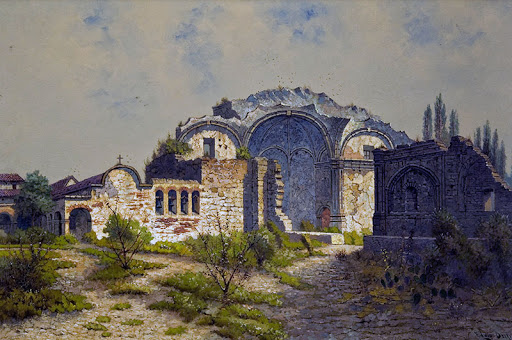
Mission San Juan Capistrano was first founded on October 30, 1775, by Father Fermin Lasuen, abandoned because of rumors of Indian attacks and re-founded November 1, 1776, by Father Junipero Serra. The name Mission San Juan Capistrano honors Saint John of Capistrano, Italy..

Interesting Facts about Mission San Juan Capistrano

  • Mission San Juan Capistrano is the only one to be founded twice
  • The swallows return to Mission San Juan Capistrano every year around March 19
  • Mission San Juan Capistrano is sometimes called "Jewel of the Missions" because of its beauty
  • The small chapel at Mission San Juan Capistrano is the only place still standing in California where Father Serra said mass

  • 1775 - 1800

    In 1775, Father Junipero Serra convinced Spanish Captain Rivera that a new mission was needed to break the long journey between San Diego and San Gabriel. On October 30, 1775, Father Fermin Lasuen founded San Juan Capistrano Mission, named for Saint John of Capistrano, Italy.

    Just eight days later, word came that Indians attacked Mission San Diego de Alcala and killed one of the fathers. The fathers at San Juan Capistrano immediately returned to San Diego, but first Father Lasuen buried the San Juan Capistrano Mission bells to keep them safe.
     
    The following year, Father Junipero Serra returned to San Juan Capistrano Mission, dug up the bells, and re-founded it on November 1, 1776.
     
    The local Indians were friendly and helped the missionaries construct the buildings and church. In 1777, they built an adobe church. In 1791, the bells were moved from the tree where they had been hanging for 15 years into a new bell tower.

    1886


    1800 - 1820

    San Juan Capistrano Mission grew quickly and soon outgrew its small chapel. In 1797, they started a new building. Completed in 1806, it was the largest mission church in California.

    The most successful year at San Juan Capistrano Mission was 1811. That year, they grew 500,000 pounds of wheat and 303,000 pounds of corn. Livestock included 14,000 cattle, 16,000 sheep, and 740 horses.
     
    In December 1812, an earthquake destroyed the church at San Juan Capistrano Mission. It killed 40 natives including two boys who were ringing the bells at the time. They did not rebuild the church.
    In 1818, the pirate Bouchard attacked the California coast, saying he fought in the name of a South American province that was rebelling against Spain. Actually, he used the revolution as an excuse to attack the California settlements.
     
    Padre Geronimo Boscano heard that the pirate was coming. He gathered the natives and fled. The Spanish guard tried to hold off the pirates, but they only succeeded in causing greater damage in the end.

    1820 -1830

    Mexico took over California in 1822. Governor Echeandia arrived in 1824; he said the Indians did not have to follow the commands of the fathers. Discipline began to break down. Then, Governor Figueroa tried to create a pueblo for free Indians at San Juan Capistrano, but it failed.

    Secularization

    In 1834, Mexico decided to end the mission system and sell the land. The 861 Indians who lived there did not want to stay.

    From 1842 to 1845, not even a single priest was left. In 1845, Don Juan Forster, governor Pio Pico's brother-in-law bought San Juan Capistrano Mission. His family lived there for 20 years.
     
    In 1863, President Abraham Lincoln returned the land to the Catholic church. However, San Juan Capistrano Mission was not kept up. In 1866, the Catholic church sent Father Jose Mut there. He found everything in ruins. The only building still standing was the chapel, which had a roof because it had been used to store hay. He tried to keep the buildings from getting worse, but he could do very little.

    1900's

    In 1910 Father John O'Sullivan came to San Juan Capistrano Mission. When he saw the condition of San Juan Capistrano Mission, he asked to take care of the ruins. Slowly, Father O'Sullivan started to restore it all by himself.

    He traded bits of the ruined buildings for new materials, cut roof beams and hired Mexican workers to rebuild the adobe walls. In 1918, he got permission to make it an active church again, which it still is. The building and grounds are partly restored, and there is a museum.
     
    San Juan Capistrano Mission is famous for its swallows, who fly south every year on October 23 and return on March 19. Legend says the swallows took up residence here to escape an innkeeper who kept destroying their nests. The swallows arrive at San Juan Capistrano Mission in groups and make their nests from mud and saliva, building them under the eaves of the buildings.