
January 30, 2015

October 1, 2014
The Mask of Zorro
1998
Storyline - The original Zorro, Don Diego de la Vega, is captured and imprisoned just as Spain concedes California to Santa Anna. 20 years go by and his mortal enemy, Don Rafael Montero, returns to California with a plan to become wealthy at the expense of the peasants. The original Zorro escapes from prison and trains a new Zorro to take his place. Much swashbuckling and derring-do ensues.
One of my all time favorite movies.
One reason, I always thought Antonio Banderas would make a perfect Zorro and he did. And two, I was introduced to Catherine Zeta-Jones who I immediately fell in love with. And the sword fight scene in the stables between Zorro and Elena is Hollywood gold.
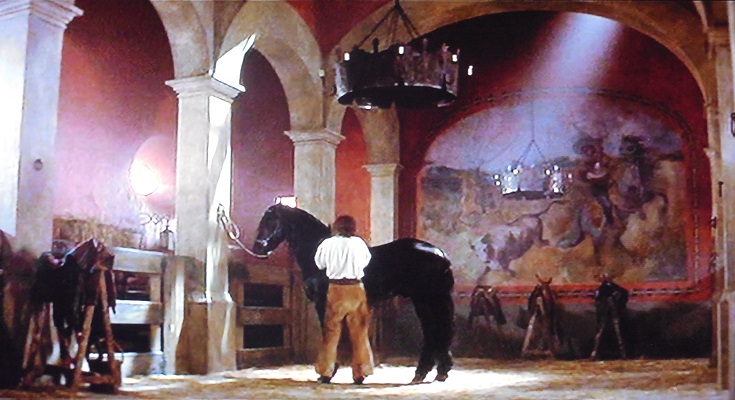
No real tauromaquia in this film but there is nice painting on the wall of the stables of a Mexican cowboy and a horse and bull.
And when Catherine Zeta-Jones says "Andalucía" in the above scene it absolutely melts in your ears.


September 24, 2014
Plaza de toros Valencia

Situated right next to the Estacion del Norte train station, Plaza de Toros de Valencia is worth a visit for its comprehensive Bullfighting Museum and for the interesting architecture that resembles Rome’s Colloseum.
Designed by architect Sebastian Monleon, Valencia’s bullring was built between 1850 and 1860, when the city’s passion for the sport was so strong it needed to be nurtured somehow. Nowadays, following two major restorations – one in 1967 and the other in 2010 – Plaza de Toros de Valencia is considered among the safest and most comfortable arenas in Spain, providing wide cement seats for up to 10,500 spectators.
Some great episodes in the history of bullfighting have taken place in the bullring of Valencia and that led to it being included in a very selective group of first-category arenas in Spain. Moreover, Valencia is where the highly anticipated Spanish bullfighting season kicks off. This happens every March, during Las Fallas – the city’s biggest, boldest and most flamboyant fiestas. The second sequence of the total of 25 bullfights scheduled in Plaza de Toros every year falls out in July.
A tour of Plaza de Toros de Valencia provides an insight into the history of Valencian bullfighting and an in-depth look at the building itself and its facilities. The Bullfighting Museum inside is one of the first of its kind in Spain, featuring a comprehensive collection of matador costumes, trophies and other artifacts that span almost three centuries of Spain’s bullfighting history.
September 16, 2014

September 15, 2014
Julian Lopez "El Juli"

Born October 3rd, 1982 in Madrid.
Took alternative in Nimes, France on September 18th, 1998.

September 13, 2014
Spain Bullish on Saving Historic Toro Bloodlines
(by Daniel Woolls latimes.com 5-13-01)
At the Miura ranch, a revered patch of the bullfighting world, bulls roam idyllic fields dotted with oak trees and wild asparagus as death awaits them in the ring.
Nasty, smart and genetically unique, the animals bred at this compound near Seville also face a threat outside the arena--shifting bullfight tastes--and could conceivably die out, aficionados fear. So to protect Miuras and other rare bloodlines, Spain is building up a bull sperm and embryo bank.
"It's part of our national heritage. It's something that belongs to all of us," said Antonio Gomez Penado, the animal husbandry expert who extracted the samples under contract with the Agriculture Ministry.
The bank is housed at a veterinary lab in Colmenar Viejo, a town just outside Madrid. Its tanks of liquid nitrogen hold enough Miura semen to inseminate 1,000 cows. There also are sperm and embryos from three other rare bloodlines, and ranches representing four more types are considering signing up, the ministry says.
Of the bulls on deposit so far, Miuras are the stars. A Miura bull can sell for as much as $11,000, said Eduardo Miura, who runs the 2,500-acre ranch with his brother, Antonio. A bull from a run-of-the-mill ranch can cost less than half that.
At the Miura estate, the bulls mostly spend their days grazing peacefully or munching on vegetable-feed pellets set out by ranch hands.
They're famously fierce, with a tall, slender physique that has been their trademark for 159 years.
Years ago, a villager sneaked onto one of the fields to pick asparagus and had the bad luck to stumble on a bull lying in the vegetation, nursing wounds from a fight within the herd and thus more jumpy and ornery than usual.
"You could tell from a distance the man was dead. He had been gored over and over," said Manuel Garcia, the ranch foreman. "The bull practically tore his clothes off."
A Reputation for Ferocity
In the bullring, Miuras have killed seven matadors through the years, more than any other bloodline. The last to fall was famous torero Manolete, gored in the groin in 1947 in the Andalusian town of Linares.
Some bullfighting buffs fear that legendary fierceness may fall victim to the unforgiving law of supply and demand.
Like any other walk of life, Spain's $4.5-billion-a-year bullfighting industry is driven by fashion. At any given time, ranches can be in or out, depending on the size, looks and temperament of the bulls they produce and how those traits sit with matadors and promoters.
In recent decades, many of the most popular bulls have come from a Seville breeder, Juan Pedro Domecq, who coined a phrase to describe his brand of bull: the toro artista, or performing bull, one that collaborates with the matador to put on a good, long, graceful show.
Purists say Domecq bulls are predictable and relatively docile, making them more manageable for matadors. Some say a Domecq bull and a matador act less like enemies than dance partners.
"Top bullfighters like Juan Pedro Domecq's bulls because they are easier to fight, less fierce. They let you get set. They are not on top of you all the time, eating up the cape," said Bill Lyon, an American bullfighting expert who has lived in Spain since the early 1960s.
Last year 44% of the 1,500 bulls killed in top-grade fights were from Juan Pedro Domecq or Domecq-based bloodlines, according to 6 Toros 6, a bullfighting magazine.
Such domination is dangerous, said Antonio Borregon, president of the Council of Spanish Veterinary Assns. "The rest of the bloodlines fall behind and could even disappear. If they are not marketable and have no commercial outlet, they will die out."
So the sperm bank was established in 1998 to set aside Miura and other choice bull genes. So far, its stock has not been drawn on to make a bull.
The bank has taken on greater importance since mad cow disease appeared in Spain last November, with more than 30 cases confirmed nationwide--although none among fighting bulls.
If a ranch like Miura were to be hit by that brain-wasting ailment and all its animals destroyed as required by Spain's health rules, the sperm bank theoretically would be able to rebuild the herd.
Deadly Sport Unlikely to Fade
Despite the threats to some bloodlines, there doesn't seem to be any danger for bullfighting itself, even though statistics suggest the deadly minuet of a man or woman teasing a proud, majestic bull and stabbing it with a sword is not everyone's idea of art or sport.
A 1998 survey found 70% of Spaniards questioned said they knew little or nothing about bullfighting, and only 4% had been to more than five fights in the last year.
Nevertheless, 80% said they were confident bullfighting would never disappear from Spain.
Animal rights groups opposed to bullfighting are a non-factor, and no Spanish politician would dream of proposing a ban for a sport that is deeply entrenched in the country's culture even if die-hard fans are a minority.
--------------------
http://articles.latimes.com/2001/may/13/news/mn-62842
At the Miura ranch, a revered patch of the bullfighting world, bulls roam idyllic fields dotted with oak trees and wild asparagus as death awaits them in the ring.
Nasty, smart and genetically unique, the animals bred at this compound near Seville also face a threat outside the arena--shifting bullfight tastes--and could conceivably die out, aficionados fear. So to protect Miuras and other rare bloodlines, Spain is building up a bull sperm and embryo bank.
"It's part of our national heritage. It's something that belongs to all of us," said Antonio Gomez Penado, the animal husbandry expert who extracted the samples under contract with the Agriculture Ministry.
The bank is housed at a veterinary lab in Colmenar Viejo, a town just outside Madrid. Its tanks of liquid nitrogen hold enough Miura semen to inseminate 1,000 cows. There also are sperm and embryos from three other rare bloodlines, and ranches representing four more types are considering signing up, the ministry says.
Of the bulls on deposit so far, Miuras are the stars. A Miura bull can sell for as much as $11,000, said Eduardo Miura, who runs the 2,500-acre ranch with his brother, Antonio. A bull from a run-of-the-mill ranch can cost less than half that.
At the Miura estate, the bulls mostly spend their days grazing peacefully or munching on vegetable-feed pellets set out by ranch hands.
They're famously fierce, with a tall, slender physique that has been their trademark for 159 years.
Years ago, a villager sneaked onto one of the fields to pick asparagus and had the bad luck to stumble on a bull lying in the vegetation, nursing wounds from a fight within the herd and thus more jumpy and ornery than usual.
"You could tell from a distance the man was dead. He had been gored over and over," said Manuel Garcia, the ranch foreman. "The bull practically tore his clothes off."
A Reputation for Ferocity
In the bullring, Miuras have killed seven matadors through the years, more than any other bloodline. The last to fall was famous torero Manolete, gored in the groin in 1947 in the Andalusian town of Linares.
Some bullfighting buffs fear that legendary fierceness may fall victim to the unforgiving law of supply and demand.
Like any other walk of life, Spain's $4.5-billion-a-year bullfighting industry is driven by fashion. At any given time, ranches can be in or out, depending on the size, looks and temperament of the bulls they produce and how those traits sit with matadors and promoters.
In recent decades, many of the most popular bulls have come from a Seville breeder, Juan Pedro Domecq, who coined a phrase to describe his brand of bull: the toro artista, or performing bull, one that collaborates with the matador to put on a good, long, graceful show.
Purists say Domecq bulls are predictable and relatively docile, making them more manageable for matadors. Some say a Domecq bull and a matador act less like enemies than dance partners.
"Top bullfighters like Juan Pedro Domecq's bulls because they are easier to fight, less fierce. They let you get set. They are not on top of you all the time, eating up the cape," said Bill Lyon, an American bullfighting expert who has lived in Spain since the early 1960s.
Last year 44% of the 1,500 bulls killed in top-grade fights were from Juan Pedro Domecq or Domecq-based bloodlines, according to 6 Toros 6, a bullfighting magazine.
Such domination is dangerous, said Antonio Borregon, president of the Council of Spanish Veterinary Assns. "The rest of the bloodlines fall behind and could even disappear. If they are not marketable and have no commercial outlet, they will die out."
So the sperm bank was established in 1998 to set aside Miura and other choice bull genes. So far, its stock has not been drawn on to make a bull.
The bank has taken on greater importance since mad cow disease appeared in Spain last November, with more than 30 cases confirmed nationwide--although none among fighting bulls.
If a ranch like Miura were to be hit by that brain-wasting ailment and all its animals destroyed as required by Spain's health rules, the sperm bank theoretically would be able to rebuild the herd.
Deadly Sport Unlikely to Fade
Despite the threats to some bloodlines, there doesn't seem to be any danger for bullfighting itself, even though statistics suggest the deadly minuet of a man or woman teasing a proud, majestic bull and stabbing it with a sword is not everyone's idea of art or sport.
A 1998 survey found 70% of Spaniards questioned said they knew little or nothing about bullfighting, and only 4% had been to more than five fights in the last year.
Nevertheless, 80% said they were confident bullfighting would never disappear from Spain.
Animal rights groups opposed to bullfighting are a non-factor, and no Spanish politician would dream of proposing a ban for a sport that is deeply entrenched in the country's culture even if die-hard fans are a minority.
--------------------
http://articles.latimes.com/2001/may/13/news/mn-62842
Subscribe to:
Posts (Atom)